

UniMORE celebrates 45 years of SINF: Modena, a birthplace of modern computing
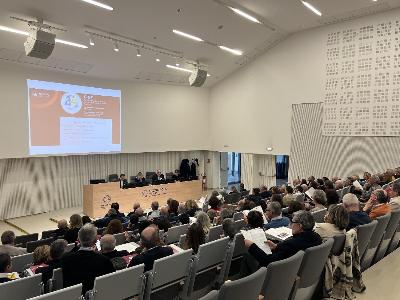
Modena was one of the birthplaces of modern computing in Italy. It was here, in 1981, that the Scuola Diretta a Fini Speciali di Informatica per Analisti di Sistemi e Procedure (SINF – Specialised School of Computing for Systems and Procedures Analysts) was established. This pioneering initiative had only one precedent of its kind in Italy, in Siena. Forty-five years after its foundation, UniMORE celebrated its history with an event in the Aula Magna at the Modena Technopole, looking back at an experience that anticipated the spread of computing across businesses and public administration.
The School was established by decree of the President of the Republic on 31 October 1981, following an initiative led by Professor Carlo Jacoboni, who oversaw its initial development. At a time when technological change was creating a demand for new professional skills, SINF introduced an innovative educational model combining theoretical knowledge, practical training and direct engagement with the world of work.
"When the School was established, computing was beginning to transform the way businesses and public administrations operated, but there were still no educational pathways specifically designed to train professionals in this field. The aim was precisely to address this need by combining theoretical knowledge with a strong practical component and direct contact with the world of work. I believe that SINF's greatest achievement was recognising, at an early stage, a need that would become increasingly important over the years. Modena was able to seize this opportunity, developing an innovative initiative that contributed to the growth of computing education at our University and throughout the local area," recalled Professor Carlo Jacoboni.
The two-year programme provided students with mathematical, statistical and computing skills, together with the tools needed to analyse and design information systems. Its practical component was particularly significant: each student was required to complete at least 500 hours of work placement at a company or public-sector organisation, gaining first-hand experience of real-world organisational challenges and requirements.
The results confirmed the effectiveness of this approach. Applications for admission rose rapidly during the School's first intakes, while the average ratio of graduates to enrolled students stood at around 88%. Almost all graduates received job offers, often even before completing their studies and, in many cases, from the very organisations that had hosted them during their work placements.
Another distinctive feature was the organisation of teaching, which relied in part on the role of the «Animatore» (Academic Coordinator), whose responsibilities included coordinating activities, supporting students and maintaining relationships with external organisations. Alongside Jacoboni, Rossella Brunetti played an important role as the School's first Academic Coordinator.
After seven two-year cohorts, the initiative came to an end as university provision evolved, contributing to the developments that would eventually lead to the establishment of subsequent degree programmes in Computer Science and Computer Engineering. SINF thus represented a significant milestone in the history of the University and the local area, demonstrating at an early stage just how strategic computing education could be for innovation and competitiveness.
Categorie: International - english, Notizie_eng
Articolo pubblicato da: Ufficio Stampa Unimore - ufficiostampa@unimore.it il 09/11/2026