
Opening of the new UniMORE AI Center, a national and international reference hub for Artificial Intelligence research
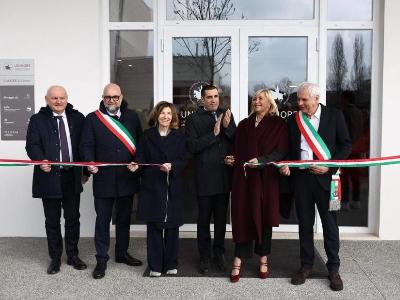
With 27 years of consolidated experience in research and innovation in the field of Artificial Intelligence, two and a half years of development work and an investment of over €3 million, the University of Modena and Reggio Emilia has inaugurated the brand-new UniMORE AI Center within the “Enzo Ferrari” Department of Engineering.
The new building is entirely dedicated to knowledge, research and the design of modern Artificial Intelligence, while also integrating training activities and technology transfer to companies across the region.
The new Centre, which represents a unique example in Emilia-Romagna and a recognised national and international reference point, hosts the AImageLab Laboratory, the AIRI Interdepartmental Centre (AI Research and Innovation Center) – accredited within the Emilia-Romagna High Technology Network and including both the AI Academy and the regional BioLab – as well as the Modena unit of ELLIS (European Laboratory for Learning and Intelligent Systems), the European scientific network that promotes excellence in AI research. The Centre also collaborates with the inter-university consortium CINECA, which includes 70 Italian universities, and with the University of Florence.
The UniMORE AI Center was established thanks to significant funding from the Emilia-Romagna Region through ERDF (FESR) funds, following a 2019 proposal supported by Confindustria Emilia and the European ELLIS network.
The Centre can host up to 60 PhD candidates and researchers, and includes experimental spaces dedicated to human-robot interaction, as well as a co-working area designed for collaboration with local companies. Numerous partnerships are already active with start-ups, SMEs and major national and international companies, including Tetra Pak, Prometeia, ENI, NVIDIA and AMD.
“The inauguration of the UniMORE AI Center represents a crucial milestone for the future of our University. With this new facility we aim to strengthen a tradition of AI research built over more than twenty-five years of work, bringing together scientific expertise, technological infrastructure and collaborations with companies and institutions. The Centre, which aspires to become a European reference point, has been created to develop cutting-edge research, train new generations of researchers and promote technology transfer, contributing to the development of the Artificial Intelligence of the future,” commented Rector Rita Cucchiara.
“The new Artificial Intelligence Centre at the Modena Technopole represents a strategic achievement for the entire Emilia-Romagna region, once again confirming its role as a European Data Valley,” stated Regional President Michele de Pascale and Vice-President Vincenzo Colla. “This centre of excellence clearly demonstrates what it means to build an effective system and to host internationally significant projects such as Elliot and Minerva. At the same time, working in synergy with the European ELLIS network and with CINECA positions our region at the forefront of research on generative models. What makes us particularly proud, however, is that the laboratories opened today will host more than fifty researchers and PhD candidates. We are creating the ideal conditions to retain and attract our best talents, enabling them to lead innovation as key protagonists. This investment looks towards the future, supporting growth and the sustainable development of the economic and social system of our region and of the entire country.”
Research in the various fields of Artificial Intelligence at UniMORE began with AImageLab, founded in 1999 by Professor Rita Cucchiara, together with Professor Andrea Prati (now Vice-Rector of the University of Parma), Professor Costantino Grana, and Professor Massimo Piccardi (University of Sydney). From its earliest years, the laboratory focused on machine learning and pattern recognition, gradually becoming an international reference point in visual analysis and computer vision. Over more than 25 years of activity, AImageLab has coordinated numerous national and international projects and produced over 600 scientific publications. In 2016, it was included among the 15 European laboratories of Facebook AI Research, receiving its first server dedicated to deep learning and laying the foundations for a powerful HPC infrastructure, which is now used to develop advanced AI models, also in collaboration with the NVIDIA AI Technical Center.
AImageLab conducts research across several areas of Artificial Intelligence and its applications. The first research area combines medical imaging and bioinformatics, with key contributions from Professor Costantino Grana and Professor Elisa Ficarra.
This research focuses on deep learning methods for analysing medical images, integrating molecular and clinical data, predicting drug responses and developing tools for personalised medicine. The studies include work on dermatological images, three-dimensional maxillofacial CT scans, and international open-source datasets developed within European projects such as DeepHealth and Decider. As a result of these achievements, the UniMORE AI Center will host the regional BioHub laboratory, promoted by the Clust-ER Health network.
The second research line focuses on video understanding for human behaviour analysis, anomaly detection, IoT and robotics. Thanks to the work of Professor Simone Calderara and his team, AImageLab has developed advanced methodologies for identifying and tracking moving objects in images and video for over twenty years, producing pioneering research widely recognised in the scientific community and releasing open-source computer vision software.
These studies have generated numerous industrial and territorial applications: from detecting stationary vehicles in tunnels in the early 2000s, to telemetry in Formula 1, railway safety, public-space security, and privacy-preserving synthetic datasets for human tracking, such as MotSynth, now used in research worldwide. Another internationally recognised resource is the large open-source dataset Drive&Act / DriveEye, developed with Panasonic USA and local automotive companies for driver gaze recognition. In parallel, research on anomaly detection has led to predictive and prescriptive tools for industrial quality control and materials monitoring, developed in collaboration with companies such as Tetra Pak, as well as projects for urban security, including the recent PNRR EcosistER initiative. Industrial research also connects with the physical world through robotics and IoT devices, with applications in human-robot interaction and embedded sensing, developed by Professor Roberto Vezzani at AImageLab and at the Carpi Technopole.
The third research area focuses on generative models and multimodal large language models, applied to text, images and video. These studies target the next generation of multimodal foundational models that are sustainable, secure and ethically designed, within European projects such as: ELSA – AI security and deep-fake detection, ELIAS – sustainability and federated learning, ELLIOT – large-scale generative language and visual models with a particular focus on video. Applications include image generation, document creation and understanding, and fashion technologies.
Large-scale model training is coordinated by Professor Lorenzo Baraldi, who leads EuroHPC large-scale projects using millions of GPU hours on the CINECA HPC infrastructure. He also manages the server centre of the UniMORE AI Center, one of the largest within Italian universities, currently comprising 25 servers and 101 GPUs, with a computing power of approximately 4 petaflops. This infrastructure has been built through donations, acquisitions and major projects, including recent PNRR initiatives such as ITSERR, Fit4MedRob and FAIR, carried out in collaboration with the Italian National Research Council (CNR) and several EU programmes. In this research area, Professor Marcella Cornia of UniMORE received the prestigious award for the best European doctoral thesis from the European Association for Computer Vision.
Since 2018, AIRI, directed by Professor Simone Calderara, has coordinated UniMORE’s interdepartmental AI activities, integrating four departments: the “Enzo Ferrari” Department of Engineering, the Department of Physics, Computer Science and Mathematics, the “Marco Biagi” Department of Economics, the Department of Sciences and Methods for Engineering in Reggio Emilia. Researchers from other departments also contribute to AIRI’s activities.
The centre also includes the AI Academy, which offers industrial training programmes and seminars for external stakeholders.
The present and future research activities of the UniMORE AI Center follow the European vision of trustworthy AI, aligned with the AI Act and the Italian National Strategy for Artificial Intelligence. The goal is to lay the foundations for Italian-born fundamental and applied research in AI that is internationally recognised, open and collaborative, and grounded in ethics, human rights, and social and environmental sustainability.
On the occasion of the inauguration of the UniMORE AI Center, two new international collaboration agreements were also signed: with the applied AI laboratory of AMD – Advanced Micro Devices, the largest private AI laboratory in Europe, to develop multimodal Vision-Language-Action (VLA) systems for robotics and autonomous driving; with Tetra Pak, through a framework agreement for scientific collaboration in Artificial Intelligence.
---
The architectural design of the UniMORE AI Center, which covers a total area of 1,200 square metres including laboratories, co-working spaces and shared areas, was developed by S.B. Arch – Studio Bargone Architetti Associati, supported by Rosmani Project for structural engineering and by T.E.S.I. Engineering together with Engineer Luigi Luccioli for the building systems design. Construction works were carried out by EFFE-GI Impianti and overseen by a team of specialists led by Architect Elisabetta Vidoni Guidoni of UniMORE, under the supervision of Engineer Stefano Savoia from UniMORE’s Technical Directorate for Buildings and Infrastructure.
Categorie: International - english, Notizie_eng
Articolo pubblicato da: Ufficio Stampa Unimore - ufficiostampa@unimore.it il 17/03/2026