
AlmaLaurea Gender Report Presented at Unimore
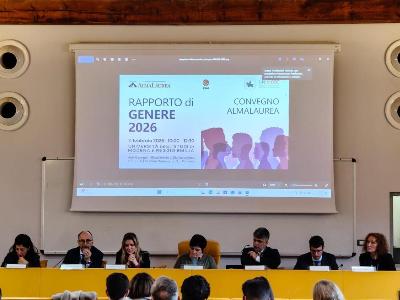
A total of 5,695 degrees were awarded in 2024 at the University of Modena and Reggio Emilia (3,302 first-cycle degrees, 1,863 two-year Master’s degrees and 530 single-cycle degrees). Women accounted for 54.5% of all graduates (55.5% in first-cycle programmes, 47.3% in two-year Master’s programmes and 74.0% in single-cycle programmes).
Female graduates are less likely to come from culturally advantaged families: 26.1% of women have at least one graduate parent, compared with 34.7% of men.
Women are also less affected by “degree inheritance”, especially in disciplines leading to freelance professions. Among single-cycle graduates, 32.2% of women earn a degree in the same disciplinary area as one of their parents, compared with 38.2% of men.
As regards pre-university education, women more often come from academic upper-secondary tracks (licei): 72.6% compared with 59.0% of men.
During their university studies, students can enrich their educational experience through various activities, including curricular internships. Among 2024 graduates at the University of Modena and Reggio Emilia, this experience is more common among women (73.6%) than among men (66.2%).
Women are also more academically consistent than men: 66.2% of female students graduate on time, compared with 55.6% of male students.
EMPLOYMENT OUTCOMES OF GRADUATES
A total of 2,178 second-cycle graduates from 2019 (1,650 two-year Master’s graduates and 528 single-cycle Master’s graduates) were contacted five years after completing their degree.
Gender differences in employment persist: the employment rate is 92.4% for women and 95.7% for men (a difference of 3.3 percentage points in favour of men).
Five years after graduation, women are less likely to hold permanent employees’ contracts (64.4% compared with 75.8% of men) and more likely to hold fixed-term contracts (13.8% compared with 4.7% of men).
These differences are naturally linked to the different professional paths pursued by women and men. Women more frequently work in the public sector (36.0% of women and 18.9% of men) and in teaching—sectors which are traditionally slower to offer stable employment, at least in the short term.
Gender pay gaps also persist: five years after graduation, women report an average net monthly income of €1,808, compared with €2,161 for men.
WOMEN AND MEN IN STEM PROGRAMMES
Focusing on STEM disciplines (Science, Technology, Engineering, Mathematics), among 2024 graduates at the University of Modena and Reggio Emilia, men account for 74.9% and women for 25.1%.
Women are more likely than men to “inherit” their degree from at least one parent (25.2% versus 12.7%).
The Five-Year Employment Survey for second-cycle graduates shows high employment levels in STEM fields, with no significant gender differences: the employment rate is 97.5% for women and 97.1% for men.
Among STEM graduates, average net monthly earnings amount to €1,942 for women and €2,242 for men.
As regards job characteristics, among women in STEM fields there is a lower prevalence of permanent employees’ contracts (-18.4 percentage points compared with men) and a higher prevalence of fixed-term contracts (+9.8 points), positions funded through scholarships or research grants (+4.0 points) and self-employment (+3.2 points).
“The AlmaLaurea Gender Report provides a snapshot of the entire university community—from enrolment choices to the early years after graduation—and invites us to consider two dimensions that often proceed on parallel tracks: the quality of education and the quality of outcomes,” commented Unimore Rector Rita Cucchiara.
“On the one hand, we see strong academic paths, with female students achieving solid results, attending regularly and participating widely in educational activities that connect study with professional contexts. On the other hand, as they transition into the labour market and progress thereafter, gaps re-emerge in employment, pay, contract stability and career progression. In STEM fields in particular, these signs take on added significance: despite high demand for expertise, the cohort remains unbalanced and the consolidation of positions progresses at different speeds. Science and technology have no gender; such imbalance signals a waste of talent and aspirations that a public university has a duty to address.”
“We therefore have a responsibility to intervene precisely at the point where the quality of study must translate into recognised opportunities and careers that progress evenly,” the Rector continued.
“This requires operational commitment to guidance already in schools, working carefully from early choices and role models, and building bridges to employment through well-designed internships, stable relationships with companies and institutions, and placement pathways that value merit and skills while reducing information asymmetry. Many inequalities stem from unequal access to networks, opportunities and early recruitment processes. Hosting this presentation means opening a shared effort, within the University and across the territory, to strengthen the presence of women in STEM, support free and ambitious choices, and ensure more uniform employment outcomes and salary levels. A university community truly flourishes only when talent and opportunity advance at the same pace.”
Categorie: International - english, Notizie_eng
Articolo pubblicato da: Ufficio Stampa Unimore - ufficiostampa@unimore.it il 12/02/2026